Apostille on documents and document legalization Business Liga
What is an apostille?
An apostille is a special stamp placed on official documents from state institutions and organizations of countries that are parties to the Hague Convention – “Hague Convention Abolishing the Requirement of Legalization for Foreign Public Documents, of October 5, 1961
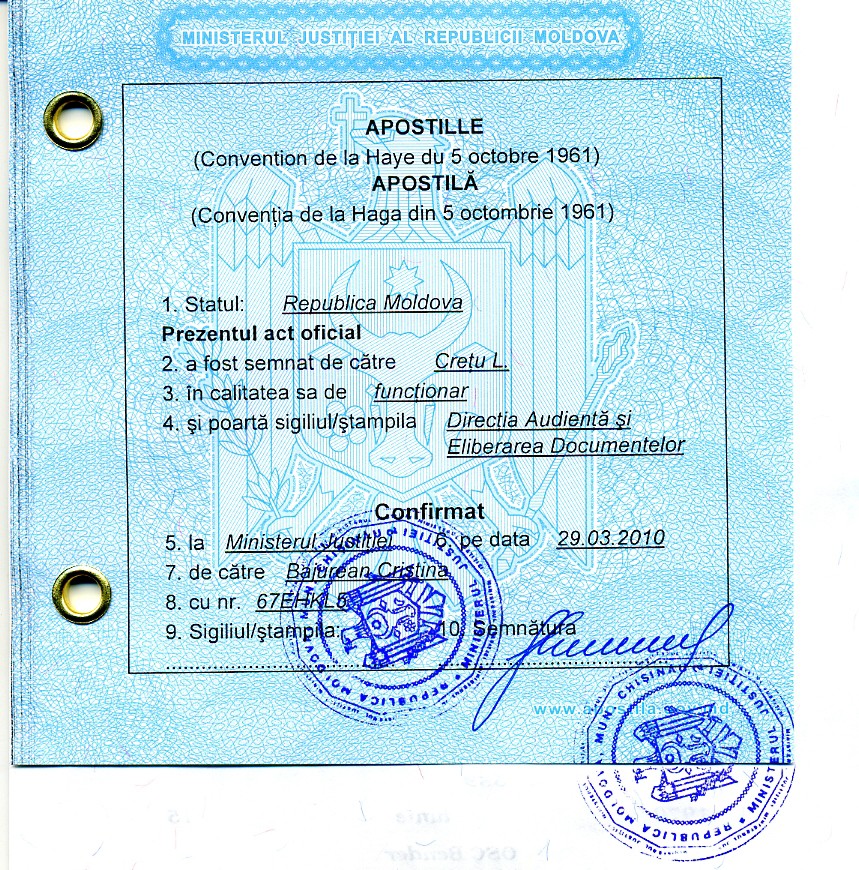
Apostille in the Republic of Moldova, example of an apostille from 2010:
The list of countries that are part of the apostille can be viewed here >>>
In the shortest possible time:
1. Apostille on documents and Legalization of documents for individuals. Consular legalization – Moldova.
Consular legalization of documents. Apostille.
Today, the Apostille in Moldova is no longer a “stamp” in the literal sense of the word. Moldova, like a number of European countries, uses an Electronic apostille. That is, the document and a special code for it are registered in the state system. A printout of the security code and the document name is issued. No wet seals are needed! Anyone wishing to verify the apostille checks it on the state website of Moldova by entering the secret code.
Documents that have received legalization in one state acquire the status of legally valid in another state for which (or for which) it was performed.
The key international document regulating legalization is the 1961 Hague Convention on Simplified Legalization.If a document that circulates among countries that have signed the convention is being legalized, the document legalization follows a simplified procedure: the competent authorities affix an internationally recognized stamp to it, and the legalization is considered complete. This stamp is recognized as legally valid by all countries that have signed the Hague Convention and is called an “Apostille.”
If a document is being legalized for a country that has not signed the Hague Convention, then the standard international procedure, known as consular legalization, is carried out. In this case, several legal actions are performed involving the Ministry of Justice of the Republic of Moldova, the Ministry of Foreign Affairs of the Republic of Moldova, and the consulate of the destination country.
Legalization for CIS countries is handled under a separate procedure. Currently, international agreements allow documents circulating within CIS countries to be considered as not requiring any legalization. There are also several other special types of documents for which legalization is not required, or for which legalization requires coordination with additional state authorities.
2. Legalization of documents for legal entities and companies.
When local companies or firms open branches, representative offices, or other firms and companies abroad, legalization is required for the founding documents, decisions of the general meeting of founders, and other statutory and internal documents of the company (firm).
3. Preparation in Moldova of any documents: criminal record certificate (follow the link), birth certificate, marriage certificate, divorce certificate, internal passport (Bulletin of the Citizen of the Republic of Moldova) – upon re-issuance, foreign passport (international passport). Also obtaining extracts for enterprises, certificates, and company statements.You can get comprehensive answers to all questions regarding legalization during a consultation with our specialists.
Our company has extensive experience in document legalization and easily overcomes any difficulties encountered in this matter.
And much more.
Call us at:
in Chisinau (Moldova)
mob.: +373 67 666 333
e-mail: [email protected]