Birth Certificate Moldova: Obtaining, Reissuance, Legalization
Your complete guide to obtaining, reissuing, and using a Moldova birth certificate from bizmoldova.com. We help you navigate all the nuances of legislation and procedures.
A birth certificate is not just a piece of paper, but a key to your rights and opportunities. It confirms your identity, citizenship, and family ties, granting access to education, healthcare, social benefits, and much more.
About the Birth Certificate in Moldova
Definition of a Moldova Birth Certificate
A Moldova birth certificate is an official document confirming a person’s birth and its registration with the civil status registration authorities (ZAGS) of the Republic of Moldova. It is the primary identity document for a child until a passport is obtained and is required for numerous legal procedures.
Types of Certificates: Original and Duplicate
The original certificate is issued upon the initial registration of a child’s birth.
A duplicate certificate is a reissued document with the same legal force as the original. It is necessary in cases of loss, damage to the original, or if a new-format document is required for use abroad.
Certificate Samples by Year and Their Validity
The format of certificates has changed over time, reflecting historical and legislative changes in the country. It is important to understand the differences, especially when using documents abroad.
Soviet-era birth certificate (MSSR)
Issued before Moldova gained independence. Often had a booklet form, were filled out by hand, and could contain entries in several languages. For international use, they usually require replacement with a new Moldovan birth certificate.
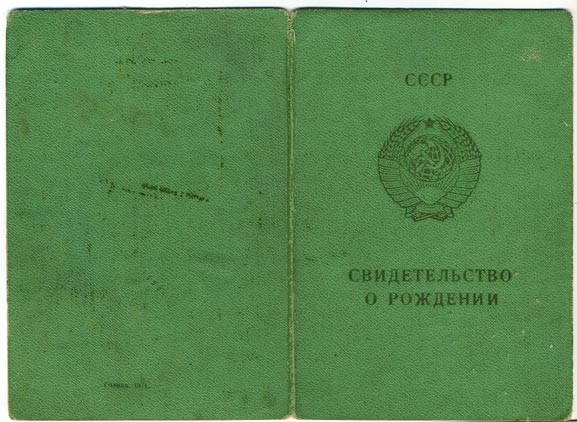
Soviet-era birth certificate
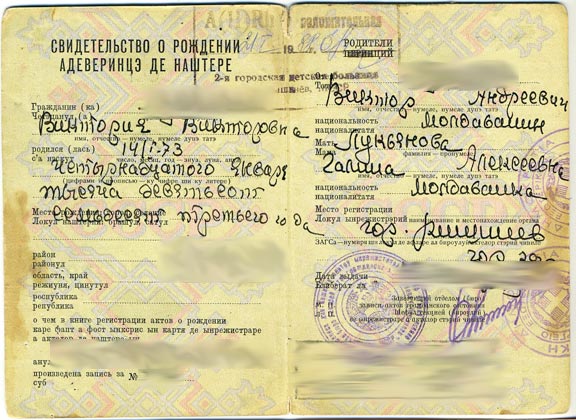
Old-style certificate. MSSR (not suitable for apostille)
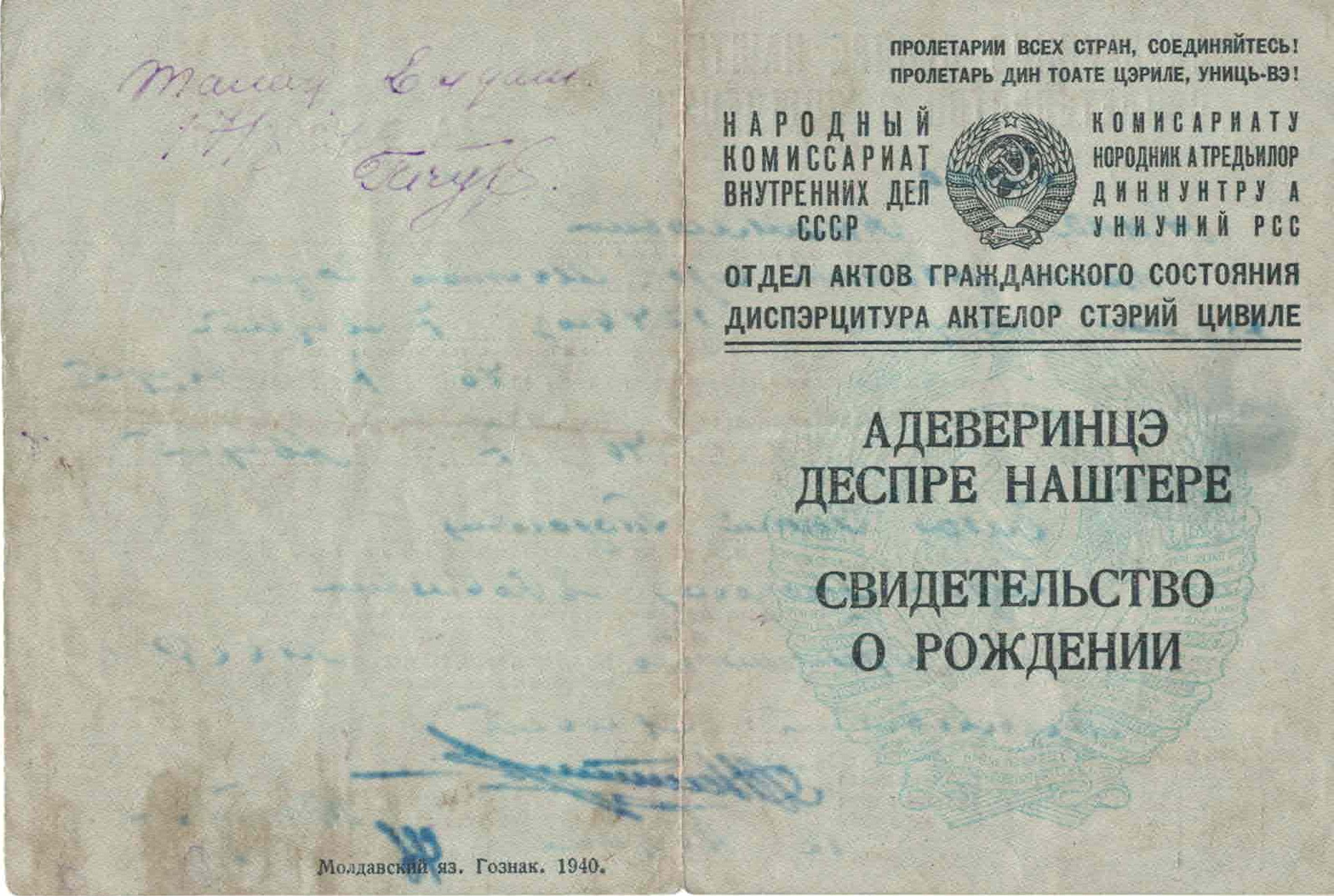
Restoration of old birth certificates from the Soviet Union era, as well as earlier periods
New Moldovan birth certificate (modern format)
Issued after independence, on standardized forms with security features. Contains the personal identification number (IDNP) and information in Romanian and Russian. This new Moldovan birth certificate is the primary document for international use.

New-style birth certificate – Moldova
Content and security features
Modern birth certificates in Moldova contain the following key information:
- Personal identification number (IDNP).
- Last name, first name, date and place of birth of the child.
- Last names, first names and nationality of the parents.
- Date of issue and serial number of the birth record.
- Gender of the child.
The forms are printed typographically and are equipped with various security features (e.g., watermarks, microtext, guilloche patterns) to prevent forgery. Civil status records are authentic state documents.
Birth Certificate Moldova and Birth Certificate Moldova
Birth Certificate Moldova (medical certificate) is a temporary document issued by a medical institution after childbirth. It serves as the basis for the initial registration of the birth with the Civil Registry Office and for obtaining a permanent Birth Certificate Moldova. The medical certificate does not have independent legal force for most civil actions.
Birth Certificate Moldova is a colloquial or general term often used to refer to the official “Birth Certificate” (certificat de naștere) in the Republic of Moldova. The legally correct and officially used name for the document is “Birth Certificate.”
Why do you need a Birth Certificate in Moldova?
A birth certificate is one of the most important documents in a person’s life, confirming their identity and civil status. It may be required in various situations:
Document Processing
A birth certificate is necessary to obtain the following documents:
- Passport of a citizen of the Republic of Moldova (both domestic and international).
- Identity card (ID card).
- Marriage or divorce certificate.
- Child documents (for example, for obtaining a medical insurance policy or enrolling in educational institutions).
Legal transactions
A birth certificate may be required for:
- Inheritance processing — confirming relationship with the deceased.
- Real estate transactions (purchase and sale, donation, lease).
- Registration of property ownership rights.
- Drafting contracts (for example, when obtaining a loan or opening a bank account).
Receiving pensions and social benefits
To apply for a pension or other social benefits, a birth certificate is necessary to confirm age and civil status.
Restoring lost documents
If you have lost your passport, ID card, or other important documents, a birth certificate can help confirm your identity and restore them.
Obtaining citizenship
A birth certificate is a key document when:
- Obtaining Romanian citizenship — to confirm origin and family ties.
- Applying for citizenship of another country — as proof of place and date of birth.
Resolving family matters
A birth certificate may be needed for:
- Establishing guardianship or trusteeship.
- Arranging child support.
- Resolving inheritance disputes.
Procedure for Obtaining a Birth Certificate in Moldova
The process of obtaining a birth certificate in Moldova is clearly regulated. It includes initial registration for newborns and obtaining a duplicate if necessary. bizmoldova.com will assist you at every stage.
Who can obtain a birth certificate?
Initial issuance (for a newborn):
- The child’s parents (one or both).
- Relatives of the parents (if the parents are unable).
- A person authorized by the parents.
- The administration of the medical facility where the birth occurred.
- The guardianship authority.
Obtaining a duplicate:
- The record holder (the person in whose name the certificate was issued).
- First- and second-degree relatives (upon confirmation of kinship).
- Legal representatives (guardians, trustees).
- Authorized representatives with a notarized power of attorney.
Ways to submit an application
- In person: At civil registry offices, mayoralties, or Moldovan diplomatic/consular missions (for births abroad).
- Online: Through the portal of the Public Services Agency (ASP) at www.asp.gov.md or www.servicii.gov.md.
- By proxy: To our employee.
Required documents for obtaining a certificate
For initial birth registration:
- Birth declaration.
- Medical certificate confirming the child’s birth.
- Parents’ identity documents.
- Parents’ marriage certificate (if applicable).
- Other documents depending on the situation (paternity establishment application, etc.).
To obtain a duplicate:
- Applicant’s identity document.
- Documents confirming kinship (if applicable).
- Notarized power of attorney (if submitted by a representative).
- Birth details (full name, date, place).
Timelines and cost of bizmoldova.com services
Initial birth registration is free of charge on the day of application. The application must be submitted within 3 months of the child’s birth, otherwise a fine may apply.
bizmoldova.com will help you obtain a Moldova birth certificate or its duplicate in the shortest possible time:
| Type of bizmoldova.com service | Processing time | Cost (from) |
|---|---|---|
| Obtaining/Restoring a certificate | from 1 to 14 days | from 50 euros |
| Urgent processing | within 24 hours | up to 100 euros |
bizmoldova.com will obtain the document for you in the shortest possible time from the relevant civil registry offices in Chisinau or other cities of the Republic of Moldova.
International Use of the Moldova Birth Certificate
To use a Moldovan birth certificate abroad, its legalization is often required. This confirms the document’s authenticity for foreign authorities. There are two main procedures: apostille and consular legalization.
Apostille for the Moldova Birth Certificate
Moldova is a party to the 1961 Hague Convention. For countries that are parties to this convention (over 120 states, including the USA, Canada, and most EU countries), it is sufficient to affix a special stamp – an apostille – on the document.
The apostille is affixed by the Ministry of Justice of the Republic of Moldova. Documents can be submitted online (https://apostila.gov.md) with an electronic signature.
Consular Legalization of the Moldova Birth Certificate
Required if the destination country is not a party to the Hague Convention or has objections to Moldova’s accession (e.g., Germany, until recently for some documents).
This is a more complex procedure involving several stages: notarization, legalization at the Ministry of Foreign Affairs and European Integration or the Ministry of Justice of Moldova, followed by legalization at the embassy/consulate of the destination country.
Translation and Notarization Services for Birth Certificates
If necessary, we will translate your Moldovan birth certificate into the required language and assist with notarization.
We provide birth certificate translation in the shortest possible time. Translation languages: English, French, German, Turkish, Serbian, Croatian, Italian, Romanian, Russian, Czech, and other European languages.
The cost of translation ranges from 50 to 400 lei per document, depending on the language of translation. Notarized certification of a birth certificate translation will cost between 30 and 40 Moldovan lei.
Birth Certificate: Obtaining, Consular Legalization, and Apostille in Other Countries
We also provide services for obtaining, legalizing, apostilling, and translating birth certificates in other countries, including:
- Russia
- Romania
- Ukraine
- Kazakhstan
- Uzbekistan
- Belarus
- Tajikistan
- Kyrgyzstan
- Armenia
- Georgia
- Estonia
- Latvia
- Lithuania
Countries Moldovans Frequently Travel To: Birth Certificate Requirements
Moldovans often travel for work or emigrate to the following countries. Below are the general requirements for a Moldovan birth certificate for these countries:
- Russia: A notarized translation into Russian is usually required. An apostille is not needed due to bilateral legal assistance agreements.
- Romania: Transcription (re-registration) of the Moldovan birth record with Romanian civil registry authorities is required, after which a Romanian birth certificate is issued. An apostille is not required.
- Italy: An apostille and a sworn translation into Italian are required.
- France: An apostille and a sworn translation into French are required.
- Germany: Consular legalization may be required for some documents (historically). It is recommended to check with the German Embassy. Moldovan civil status documents in Romanian, not older than one year, may be legalized by the German Embassy.
- United Kingdom: Apostille required. Translation into English if the document is not in English.
- Portugal: Apostille and sworn translation into Portuguese required.
- Spain: Apostille and sworn translation into Spanish required.
- Israel: Apostille and notarized translation into Hebrew required.
Important note: Document requirements may change. It is always recommended to verify current information with the consulate or embassy of the relevant country before submitting documents.
Pridnestrovie: Specifics of Using Moldovan Birth Certificates
Using a Moldovan birth certificate in the territory of Pridnestrovie (Left Bank of the Dniester) has its own unique features due to the region’s unrecognized status. Standard international legalization procedures, such as apostille or consular legalization, are not applied here.
Recognition of Moldovan Documents in Pridnestrovie
In the territory of Pridnestrovie, its own de facto regulations are in effect. To use a Moldovan birth certificate, a notarized copy and/or a translation into Russian performed by local notaries or translation bureaus in Pridnestrovie is generally required. It is important to understand that translations and certifications performed in Moldova may not be automatically recognized in Pridnestrovie, and vice versa.
Pridnestrovian authorities may require verification of the authenticity of a Moldovan document through their internal procedures, which may vary depending on the specific institution and the purpose of using the document.
Cases Involving Russian Passports
Citizens who hold Russian passports and Moldovan birth certificates issued in the Republic of Moldova may need to confirm the legitimacy of the Moldovan document for Pridnestrovian authorities. In such cases, the following is often required:
- Obtaining a duplicate of the Moldovan certificate in the new format (if the original is old or lost).
- Performing a translation of the Moldovan certificate into Russian.
- Notarization of the translation.
However, even after these procedures, recognition of such a document in Pridnestrovie will depend on the internal rules of local authorities and the current relations between Chișinău and Tiraspol. We recommend clarifying the current requirements directly with the institutions in Pridnestrovie where the document is intended to be used.
Cases with English-language entries
Moldovan birth certificates are issued in Romanian and Russian. If the document contains entries in English (for example, if it was a translation made for use in other countries), this may raise additional questions when submitting it in Pridnestrovie. For Pridnestrovian authorities, the most relevant and required version will be a translation into Russian.
Any entries in English that are not part of the official form or its standard bilingual content may require additional clarification or a separate translation, certified in accordance with Pridnestrovian norms.
Dual birth registration
Some citizens born in Pridnestrovie may have received a birth certificate from the de facto authorities of Pridnestrovie and then registered the birth with the civil registry offices of the Republic of Moldova, obtaining a Moldovan certificate. In such cases, to use the Moldovan certificate in Pridnestrovie, confirmation of its compliance with local requirements may be necessary.
Conversely, for Pridnestrovian documents to be recognized in Moldova, you must apply to the authorized civil registry offices of the Republic of Moldova (e.g., in Varnița, Anenii Noi) with a document issued by local Pridnestrovian civil registry authorities and an identity document issued by the competent authorities of the Republic of Moldova or another state.
We can assist in obtaining notarized copies and translations that may be recognized on the territory of Pridnestrovie; however, we cannot guarantee their full legal recognition due to the unresolved status of the region. It is recommended to verify the current requirements directly with the institutions in Pridnestrovie where the document is intended to be used.
Complex Cases: Correction and Amendment of Data in a Birth Certificate
Sometimes, when requesting a Moldova birth certificate, non-standard situations arise. Moldovan legislation provides ways to resolve them, but they may require additional effort and time.
Procedure for correcting errors in a birth certificate in Moldova
If errors, inaccuracies, or incomplete information are found in the certificate or civil status record (e.g., incorrect date of birth, name, surname, typos, incorrect form completion), this renders the document invalid. To correct it, you must contact the civil registry office at your place of residence or at the place where the record was made. If there is no dispute (e.g., an obvious typo), the civil registry office will make the corrections and issue a new duplicate. In the event of a dispute (e.g., data discrepancies requiring proof), the matter can only be resolved through the court.
Procedure for making amendments to a birth certificate in the Republic of Moldova
To make changes to a Moldova birth certificate (e.g., change of surname, first name, parents’ nationality), an application is submitted to the Civil Status Office at the applicant’s place of residence. Such changes are made in the absence of a dispute. If there is a dispute, the matter is examined in court. bizmoldova.com can assist with this process.
Loss of Civil Status Records or Certificates
If a certificate is lost or damaged, a duplicate is issued. If the registers (record books) themselves are lost, the civil status record may be restored upon application.
Birth on the Left Bank of the Dniester and the Municipality of Bender
The fact of birth and registration in these localities may be certified based on a document of birth issued by the local Civil Status Offices of these territories. The applicant applies to the authorized Civil Status Offices of the Republic of Moldova (e.g., in Varnița, Anenii Noi) with this document and an identity card issued by the competent authorities of the Republic of Moldova or another state.
Other Complex Scenarios
Such cases include: submitting a birth application after the established 3-month deadline, registering the birth of a found/abandoned child. In these situations, additional documents or court decisions may be required.
Moldovan Legislation on Birth Certificates
Procedures related to civil status acts in Moldova are regulated by a comprehensive legal framework. Understanding the key laws and competent authorities will help you better navigate the process.
Key Legislative Acts
| Name of the Act | Main Content |
|---|---|
| Law No. 100/2001 on Civil Status Acts | Defines the procedure for registration, modification, and restoration of civil status acts. |
| Constitution of the Republic of Moldova | Establishes the right to a name and citizenship. |
| Government Decision No. 966/2020 | On services provided by the Public Services Agency (ASP), including tariffs and deadlines. |
| Law on State Duty No. 213/2023 | Defines the amounts of state duties and cases of exemption from payment. |
Competent Authorities
- Public Services Agency (ASP): The central body responsible for registering civil status acts.
- Civil Registry Offices: Territorial subdivisions of the ASP.
- Mayoralties of Localities: Carry out registration in localities where there are no civil registry offices.
- Diplomatic Missions and Consular Offices of the Republic of Moldova: For Moldovan citizens abroad.
- Ministry of Justice: Provides oversight and is responsible for the apostille procedure.
Frequently Asked Questions about the Moldova Birth Certificate
Here are answers to the most frequently asked questions regarding obtaining a Moldova birth certificate.
How long is a birth certificate valid?
A birth certificate is an indefinite document. However, for some procedures (especially abroad), a document with a “fresh” issue date (a duplicate) may be required, usually no older than 6 months or 1 year.
What should I do if the birth certificate is of the old Soviet model?
Old-style birth certificates (from the Soviet Union) can currently only be used within the country where they were issued during the USSR. To submit documents abroad, you will need to exchange the certificate for a new Moldova birth certificate. To do this, you must contact the Civil Registry Office with a request to issue a duplicate.
What if the certificate has no signature or it is illegible?
The absence of a signature or an illegible signature of an official renders the certificate invalid for official use. In this case, you must contact the Civil Registry Office at the place of issuance to obtain a duplicate. The new duplicate will contain all necessary elements, including a clear signature.
What if the seal on the certificate is illegible?
An illegible or missing seal from the Civil Registry Office renders the certificate invalid. To restore the legal validity of the document, you must obtain a duplicate from the relevant Civil Registry Office. The new document will be issued on a form with a clear seal.
What if the certificate lacks complete data?
If the certificate lacks mandatory information (e.g., the parents’ nationality, if it was indicated in the civil record, or other required data), the document may be considered incomplete. In such a case, you must contact the Civil Registry Office to make changes or obtain a duplicate with complete data, based on the civil record.
What if there is an error in the certificate (types of errors and how to resolve them)?
Errors in a certificate can be factual (incorrect date of birth, first name, last name) or technical (typos, incorrect form completion). Any error renders the document invalid. To correct it, you must contact the Civil Status Office (ZAGS) at your place of residence or at the place where the civil record was made. If there is no dispute (e.g., an obvious typo), the ZAGS will make corrections and issue a new duplicate. In case of a dispute (e.g., discrepancies in data requiring proof), the matter can only be resolved through the court.
Why is a seal needed if the certificate is issued on a special form?
Even if the certificate is issued on a special form with security features, the seal of the ZAGS authority is a mandatory element confirming the official origin of the document and its legal validity. It serves as an additional measure of protection against forgery and certifies that the document was issued by an authorized state body.
Why is an apostille needed if there is an official seal and the official’s signature?
The official seal and the official’s signature confirm the authenticity of the document and the authority of the official only within the territory of the Republic of Moldova. An apostille is a special stamp that confirms the authenticity of the signature, seal, and status of the official who issued the document for its use in countries that are parties to the Hague Convention. This is a simplified form of international legalization that makes the document valid abroad without additional consular legalization.
Why is consular legalization needed for a birth certificate in Moldova if there is a seal and the official’s signature?
Consular legalization is required for using a Moldovan birth certificate in countries that are not parties to the Hague Convention. This is a more complex, multi-stage procedure involving certification of the document by the Ministry of Justice, the Ministry of Foreign Affairs of Moldova, and then by the consulate or embassy of the destination country. The official’s seal and signature authenticate the document for Moldova; consular legalization makes it valid in a specific foreign country not party to the Hague Convention.
Which countries most often require a translation of a Moldovan birth certificate to be done in their territory, in their country?
Most countries whose official language differs from Romanian or Russian (the languages in which Moldovan certificates are issued) will require a translation of the document. This often must be a sworn translation performed by a certified translator in the destination country, or a translation done in Moldova and notarized, then apostilled/legalized. For example, Western European countries (Italy, France, Spain, Portugal), the USA, Canada, Israel.
Why is the patronymic not indicated in a Moldovan birth certificate and what to do about it?
In the Republic of Moldova, the patronymic is not a mandatory part of the name for all citizens. In new birth certificates, it may not be indicated if it was not specifically requested. If a patronymic is required for using the document in another country, an additional procedure may be needed to add it to the civil registry record, or to prepare a notarized statement/affidavit confirming the patronymic.
If the certificate has incomplete data, can it be filled in by hand?
No, adding data to an official document by hand is strictly prohibited. Any changes or additions can only be made by the civil registry office after completing the appropriate procedure for correcting or supplementing the civil registry record. A document with handwritten additions will be considered invalid.
If there is an error in the birth certificate, can it be corrected with a pen or on a computer?
No, under no circumstances should errors in a birth certificate be corrected with a pen or on a computer. This will render the document invalid. All corrections must be made only by the civil registry office that issued the document, following the official procedure for amending the vital record. As a result, a new duplicate certificate with corrected data will be issued.
Will a damaged birth certificate be accepted?
Documents with significant damage (torn, with missing text parts, illegible elements, water stains, etc.) are generally not accepted by official authorities. In such cases, it is necessary to obtain a duplicate birth certificate.
Will a birth certificate with handwritten corrections be accepted?
No, a birth certificate with any handwritten corrections (or any unauthorized corrections) will be considered invalid and will not be accepted by official authorities. All changes must be made by the civil registry office according to the established procedure.
What are the requirements for the condition of a birth certificate?
A birth certificate must be in perfect condition: intact, without tears, stains, extraneous notes, or corrections. All data, seals, and signatures must be clearly legible and undamaged. The document must not be laminated.
What to do if there is a discrepancy between the birth certificate and other documents?
Discrepancies in data (e.g., in name, surname, date of birth) between the birth certificate and other documents (passport, marriage certificate) are a serious issue. You must contact the civil registry office to correct the birth record. If the discrepancy is obvious and undisputed, the registry office may make the changes. In more complex cases or in the event of a dispute, correction is only possible by a court decision.
Can a birth certificate be laminated?
It is strongly not recommended to laminate a birth certificate or any other official documents. Lamination makes it impossible to affix an apostille, additional stamps, or marks, and may conceal potential alterations to the document. Many state and foreign authorities do not accept laminated documents.
How long is a birth certificate valid?
A birth certificate is an indefinite document. However, for some procedures (especially abroad), a document with a “fresh” issue date (a duplicate) may be required, typically no older than 6 months or 1 year.
What is the difference between a birth certificate and a birth record?
A birth certificate is the primary, permanent legal document confirming the fact of birth and the registration of a civil status act. It is issued by the civil registry office on a special form and has indefinite validity. A birth record (medical) is a temporary document issued by a medical institution after childbirth, serving as the basis for the initial registration of the birth with the civil registry office. A medical record does not have independent legal force for most civil actions.
What is the difference between a birth certificate and a birth registration record?
A birth registration record is the primary, original record of a birth, which is stored in the archives of the civil registry office and is the original source of information. A birth certificate is an official extract from this registration record, a document issued to the citizen based on the data contained in the registration record.
What is the difference between a birth certificate and a birth certificate (certificat de naștere)?
In the context of the Republic of Moldova, “свидетельство о рождении” (certificat de naștere) is the precise and official legal term for the document issued by the civil registry offices. The term “birth certificate” is often used as a more general or colloquial equivalent, especially in English-speaking countries. However, in Moldova, the official document with legal force is precisely the “Birth Certificate” (Свидетельство о рождении).
Why choose bizmoldova.com?
All actions related to obtaining, requesting, legalizing, and apostilling a Moldova birth certificate are completely legal and are carried out based on the power of attorney received from you.
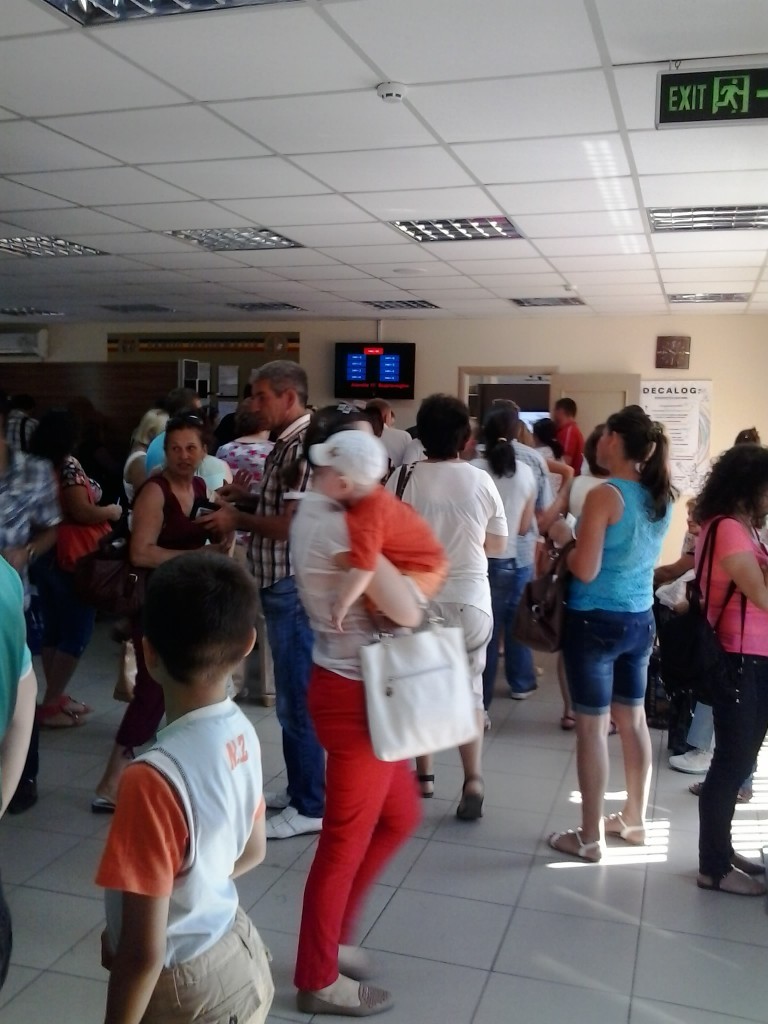
Queue for submitting an application to obtain documents from the Civil Registry Office. Most citizens are obtaining documents for Romanian citizenship.
What to pay attention to when ordering a birth certificate from Moldova through agencies and translation bureaus located not in Moldova, but abroad:
Keep in mind that these agencies are intermediaries and do not have sufficient information or competent staff to handle matters in Moldova.
Let’s call this our review of the “Gulfstream” translation bureau. This agency gives recommendations without having the necessary information about documents in Moldova. For example, we quote: “you can obtain duplicates of the relevant documents only from the Civil Registry Office in Moldova that issued them.” But this is not true!
Trust those who have experience, trust the professionals! We have been working in this field for 19 years.